Nursery spare clothes: planning a set that stays useful
30 October 2026 · Koalinus editorial team

There is still a bodysuit in the nursery cubby, but the matching trousers have been at home since the last change. A useful supply of spare clothes needs more than a packing list. It needs a simple return route: used pieces go back after washing. This guide helps you plan that cycle without buying a second wardrobe just in case.
Start with your nursery's own list
Before packing, ask which spare clothes should stay at nursery, how much storage space is available and how used pieces come home. Check how staff identify clothing and what labelling they expect. Sleep equipment, footwear and outdoor clothing belong on the nursery's separate list; this article covers the spare-clothes supply only.
Two German nurseries show how lists can differ. Krabbelstube Hoppetosse lists bodysuits or underwear, socks or tights, trousers, a T-shirt and a jumper among its items. Labelling is optional there. Kita Naseweis explicitly asks for names on clothing and for spares to be changed seasonally and checked for completeness. These are individual nursery examples, not universal requirements.
Pack replaceable pieces, not favourite outfits
Lay out clothes you already own that fit now. For your child, check the layer worn next to the skin, the top, trousers and socks. A bodysuit and underpants are not automatically two extra items to pack; the choice depends on what your child wears. Tights may combine two positions. The useful question is whether the spares can make a complete, well-fitting combination again.
Check that neck openings and fastenings work well in everyday use. The label size alone is not enough. Our size comparison guide explains how to use a piece that already fits as a reference. A spare bodysuit that has become too short is not useful simply because it has barely been worn.
Use a small stock note instead of a fixed quantity
One number for every child would not help much here. Agree an initial supply with staff, then adjust it to the changes your child actually needs. The following note is a planning template to fill in, not a recommended minimum:
- Agreed cubby supply: tops ___ / trousers ___ / bodysuits or underwear ___ / socks ___.
- Currently at nursery: ___; at home in the wash: ___.
- To replace at the next drop-off: ___.
- Fit and season last checked: ___; next personal reminder to check: ___.
If the same item keeps running out, address that item specifically. More complete outfits will not solve every stock problem. Before buying, see whether a suitable piece from the clothes you already own can stay at nursery.
Connect used clothes to a refill reminder
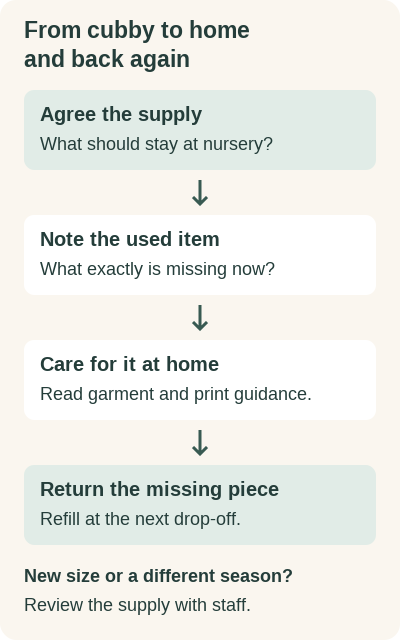
At collection, write down the missing piece rather than just “refill the spare bag”. After caring for it, put it in the bag for the next nursery day. If washing and returning clothes regularly takes longer than the supply lasts, discuss the reserve again. Follow the garment label and any additional print instructions, not a universal nursery wash temperature. Our printed baby clothing care guide helps you compare the instructions.
Label pieces as your nursery requests. Keep size and care information readable, and follow the application instructions for any added marking. This article does not assess labels, stamps or pens for durability or suitability.
Include the cubby when checking size or season
Include the nursery supply in your next fit check. Hoppetosse specifically notes that clothes stored there are easily forgotten. Replace pieces that are too small, and also check that the combination still suits the season as agreed with staff. That keeps a one-off packing list useful over time.
If you look for another top, check model-specific sizes and fastenings rather than choosing by design alone. Our baby T-shirt page shows product previews; ordering is not available yet. The previews do not establish particular nursery suitability or durability for those models.